Two years have passed since I said that .NET was one of the best bets in modern development. Today, in 2026 with .NET 10, I stand by it: not only is it still worth it, it is better than ever. And we are going to look at the reasons.
Table of contents
1 - Is .NET still worth it in 2026?
In 2024 we talked about .NET consolidating as a modern, cross-platform platform. In 2026, that reality is even more obvious. It has been 10 years now since it has been possible both to deploy on Linux and to develop on Linux or Mac.
With the recent arrival of .NET 10, Microsoft has continued with the idea of updating the framework version year after year, bringing significant improvements with every release. Not only in performance, where we can see 10% or 20% improvements in an application just by changing the version, but also in richer capabilities across the stack.
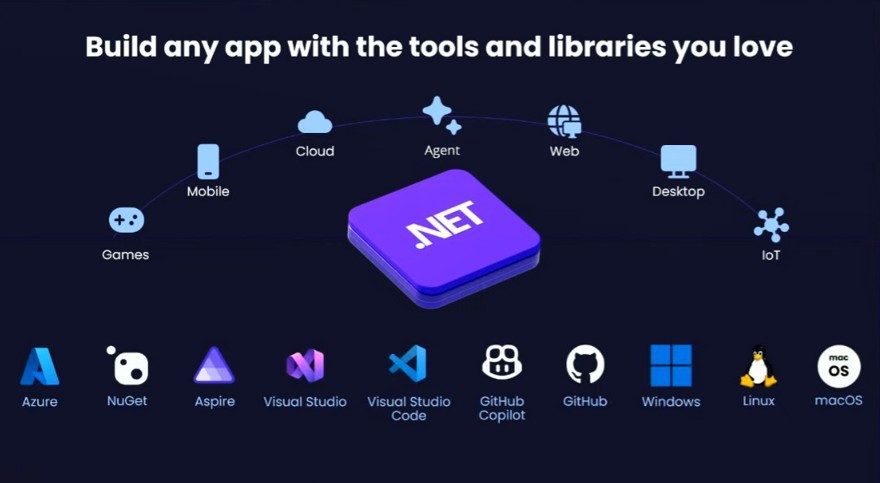
You notice this especially if you are on .NET Framework, where just by moving from .NET Framework to modern .NET you are going to get an exaggerated performance boost.
If it happens that the project you work on is still on .NET Framework, tell your boss to invest time in migrating to .NET, you will notice it a lot. There is also dotnet assistant to make the migration easier.
2 - .NET keeps growing
The most significant changes in the ecosystem have come from how we configure certain actions, or rather, how we do them. .NET and C# in particular have always been famous for having a lot of boilerplate code, very "big company". That is not exactly true anymore.
Today we can run .cs files (the C# extension) as if they were a Python script: you simply write the code and run it from the terminal. All you need is one file, you do not need a big structure like it used to be.
You can see more details about this feature here.
Scripting did not arrive overnight. It has been progressive: at first, we kept removing content from each file until we were left only with what matters. That is why today C# projects are much smaller and easier to understand at a glance.
The clearest example is in an API, where we have a new capability called "minimal API". And even though it has been around for 4 years, you can tell Microsoft is giving it love because it has the same capabilities as the ASP.NET controllers "we have always had". Now we have both options, and you are the one who gets to choose. All without third-party libraries.

And native support for many of the tools developers use is becoming the norm, which is appreciated.
2.1 - Cloud native with Aspire
Another big shift comes with Aspire, which is here to solve the same distributed development challenges I was already exploring in my project Distribt (which is what it is, for sure), but now with native Microsoft backing. The reality is that over the last two years, Aspire has grown a lot.
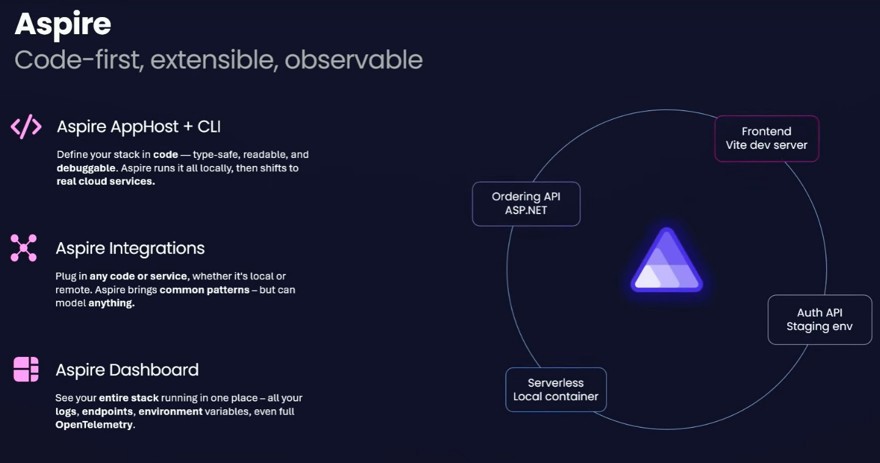
What started as a small framework that lets you simplify the experience of developing connected services for local development has evolved into a complete orchestration and observability environment, making life easier for all of us who work with it.
Maybe in 2026 I will create a new video about Aspire, since I use it daily in my day-to-day work.
3 - The .NET ecosystem and tools
A framework is nothing without its tools and its ecosystem. In 2026, the .NET ecosystem is one of the reasons to choose it. It is not just "Microsoft" and the force that can bring, the community is there too.
And in my opinion, one of the biggest advantages is that you can do absolutely everything with a single language.
3.1 - Full stack with one language
Backend development: I am not going to go into explaining the benefits of backend development with .NET (C# or F#) again since it is its biggest use. I will just mention that it is a very mature environment and widely used in the enterprise world.
For web development: You have Blazor. It keeps maturing at an incredible pace, allowing you to build interactive web user interfaces using C# instead of relying exclusively on JavaScript. Whether on the server (Blazor Server) or directly on the client (Blazor WebAssembly), the promise of sharing business logic between the frontend and the backend is a reality that, when building full stack applications, saves a lot of time. Blazor course link.
For cross-platform development (mobile and desktop, or even web): Microsofts own MAUI. It is the evolution of Xamarin and allows you, with a single project, to target Windows, macOS, Android, and iOS. But there are also fantastic, mature alternatives like Uno Platform or Avalonia that teach us a lesson about not being locked into a single framework.
3.2 - .NET tools that change the game
We can say without fear of being wrong that .NET tooling has always been in a different league.
Development environment: here we will clearly talk about Visual Studio 2026, which remains a very important IDE, where it no longer works only with .NET languages, it is now compatible with virtually any other language. Of course, Microsoft also owns VS Code and now supports DevKIT for C# development, although in my opinion the best IDE is JetBrains Rider, as you can see in any of my videos.
The package ecosystem: NuGet is a mature repository with millions of packages that solve almost any problem imaginable. Dependency management has changed a lot, especially since the arrival of .NET Core simplifying things, although I am not sure whether it is NuGet itself or the IDEs that have improved. Also, in October 2025 they added to NuGet the possibility of being sponsored.
3.3 - Beyond the web: AI, games, and the cloud
Artificial Intelligence (AI): With the rise of LLMs, .NET has not been left behind. Integration with Semantic Kernel (Microsofts SDK for orchestrating prompts and AI) is native. This lets you build incredibly powerful applications that integrate OpenAI or Azure services in a simple way. If you want to develop locally without depending on the cloud, you can do that too, as we are seeing in the AI course on this platform.
Gaming: We cannot forget that Unity, the most popular game engine in the world, uses C# and the .NET runtime (although with its own fork). This means that millions of game developers are, essentially, .NET developers.
Cloud: The .NET ecosystem is designed for the cloud. Integration with Azure is total (App Services, Functions, Containers), but .NET is agnostic: it works perfectly on AWS, GCP, or on your own Kubernetes cluster.
If you are interested in the cloud world or distributed systems, remember that I have my book for sale, building distributed systems
4 - So, is .NET worth it in 2026?
Two years later, my conclusion not only stands, it is reinforced. .NET has kept evolving at a breakneck pace, improving performance, expanding its ecosystem, and establishing itself as one of the most complete and versatile development platforms on the market.
Nowadays .NET is a solid, modern, productive environment. It is true it does not have the hype of other frameworks, but it has stability and constant evolution. If you are thinking about starting a career in the software development world, or if you are an experienced developer looking for a technology with a future, .NET is, without a doubt, one of the best bets you can make.